To Exist Is to Change
Tomorrow is today. If we or our organizations are waiting for things to get better, we’re missing the point: It’s up to us to make things better now.

Tomorrow is today. If we or our organizations are waiting for things to get better, we’re missing the point: It’s up to us to make things better now.

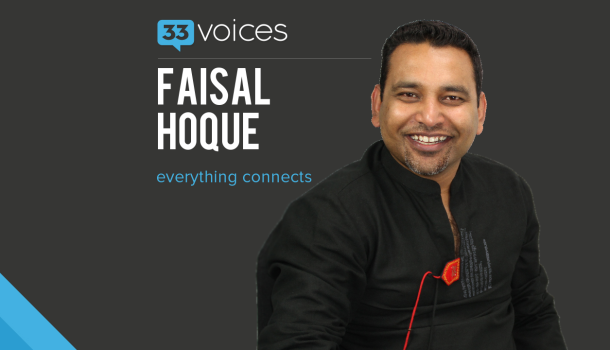
A Bangladesh-born management guru, Faisal Hoque, explains how “mindfulness” can transform your business.

You Have An All-Star Team and Vision For Miles — What’s Missing? Bring Your Focus Back To Your People’s Potential with These Tips Form The Authors of Everything Connects.

On Friday, February 14th at 12pm ET Join Fast Company’s leadership editor Kathleen Davis as she interviews authors (and Fast Company contributors) Drake Baer and Faisal Hoque. Join Fast Company contributors Faisal Hoque and Drake Baer for a conversation with Fast Company Leadership editor Kathleen Davis — they’ll be discussing what it means to truly be a great leader in 2014. Enter your email to receive an email reminder when the event starts – click here. Drake and Faisal are the authors of a new book, “Everything Connects” — read a review of the book here. A former executive at General Electric and other multinational companies, Faisal has founded a number of companies, including Shadoka Ventures, and is the author of six other books,


33voices recently sat down with Faisal Hoque, serial entrepreneur and author, to how to transform and lead in the age of creativity, innovation, and sustainability.

The business world is a symphony of players and elements that only works when everything interconnects harmoniously. Continuous innovation and continuous learning are required for any sustained connection and success.

Resilient people develop a mental capacity that allows them to adapt with ease during adversity, bending like bamboo instead of breaking. They possess a set of powerful traits. I’ve shared some of these traits separately in my previous posts; in this article, I wanted to bring them all together.

Nobody succeeds in a silo. To survive and ultimately thrive we must effectively create partnerships with many around us.

Being holistic and humanistic is key to a great life and doing great work.

Who doesn’t want to figure out how to get more done? Or get things done more efficiently? We asked some of the most productive people we know how you can tackle the New Year’s work. BY KATHLEEN DAVIS | January 2, 2014 ESCAPE INTO SINGLE-TASKING Author and entrepreneur Faisal Hoque has mastered the art of doing one thing at a time. In fact he’s so good at “single-tasking,” that he can lose himself mundane task like vacuuming and help ground his focus for his work. “Being in the moment allows us to escape from adversity, conserve our inner energy, and be more consciously productive,” he says. Read the full article @FastCompany.

Navigating our journey requires the constant adaption of our path. And adaption in the face of adversity often requires unorthodox, vivid imagination.

“The greatest glory in living lies not in never falling, but in rising every time we fall.” – Madiba

A beginner’s mind, then, is what allows us to embrace the highest emotional qualities such as enthusiasm, zeal and optimism to creatively move ourselves forward.

Hoque shares his unique perspective on connecting with yourself to find success in the professional world – and why simplicity always wins.

If something sustains, it continues over a period of time. Living things grow. Sustainable growth for an organization requires leaders to act as a catalyst. What’s crucial, then, is to understand the nature of catalysis.

Although many things have changed over the years, the fundamentals of execution, management, and governance remain the same. The industry (both private and public sector) is littered with failed complex business and technology initiatives such as the Healthcare.gov launch.

For me, to unplug is to give up craving, to live mindfully, to move toward nirvana (Sanskrit for “complete liberation”).

All people–and disciplines–access the world through their own perspectives, carrying narratives and baggage they do and do not see.