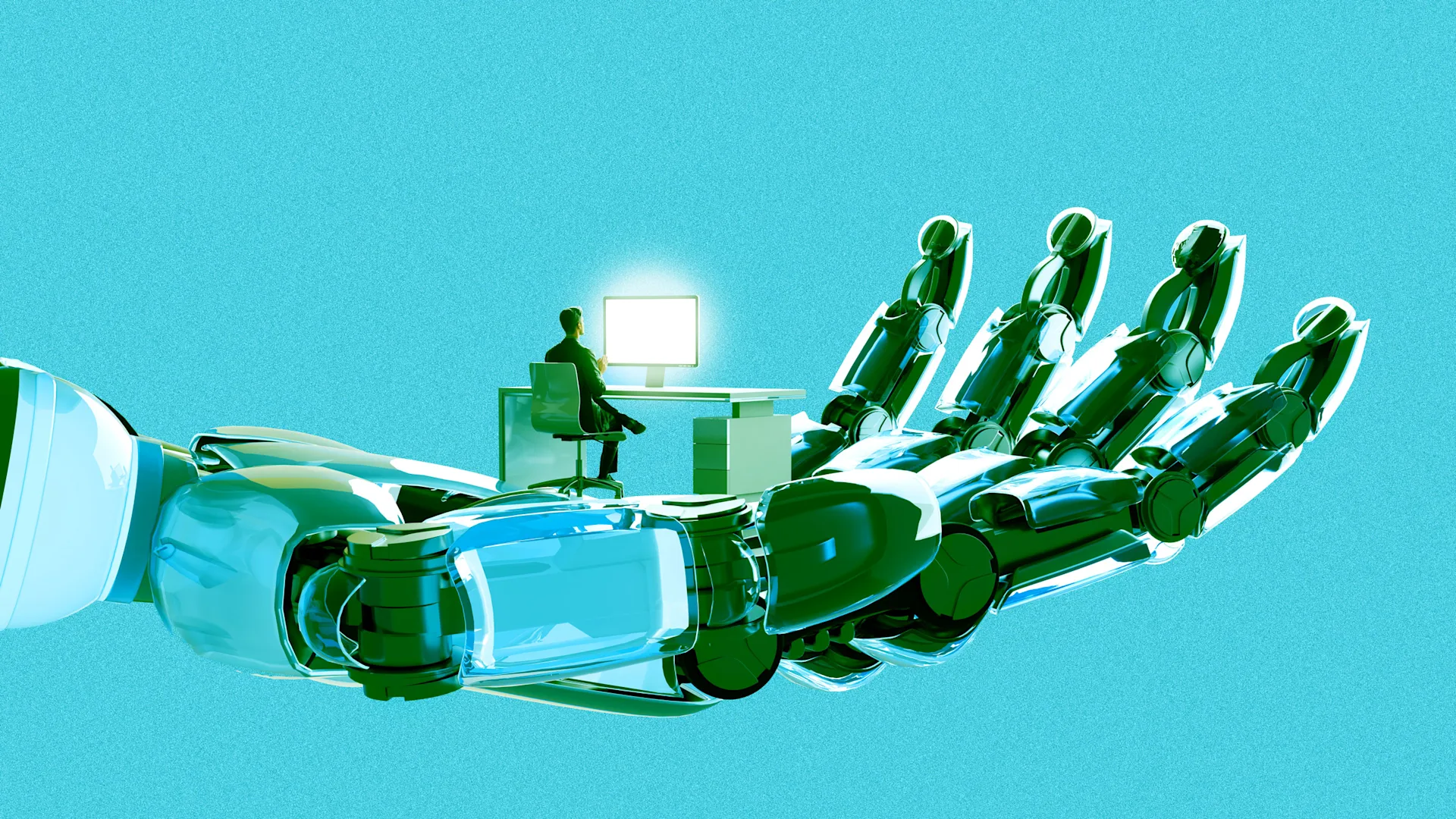

As AI takes over cognitive tasks, knowledge workers face a crisis of meaning. Finding fulfillment requires redefining what makes work worthwhile.
KEY POINTS
- AI handles tasks efficiently but creates distance from work.
- The IKEA effect shows we value what we build ourselves; AI removes that struggle and, with it, the meaning.
- Embrace the shift from doer to orchestrator.
- Reframe success around human impact: who you helped, what became possible, not what boxes you ticked.
AI is becoming a routine part of how we work. People use it to draft emails, take notes in meetings, write reports, create presentations, develop strategies, and a whole lot more. And this is very much a one-way street with a clear direction of travel: As AI develops, and as humans become more comfortable with using it, more and more of our cognitive work will get offloaded to our digital helpers.
But what is then left for us? When AI handles most of the items that normally populate our to-do list, where will we find satisfaction and meaning in our work?
This isn’t just an interesting philosophical question. It’s a deeply practical question that all knowledge workers should be asking, because, unless we find the answers, we will be doomed to unhappy and disengaged working lives.
The Changing Nature of Work
AI won’t just do more of our work for us. Much more important, AI is changing the nature of work.
Consider how we used to approach a problem. We might spend an afternoon brainstorming solutions, sketching possibilities, discarding dead ends, and gradually working our way toward an answer. Now we might describe the problem to an AI model, ask it to generate 10 different approaches, and pick the one we think is best. Or consider writing an important email. We used to draft it ourselves, choosing each word carefully, reworking sentences until they landed right. Now we might describe the message we want to convey, let AI write the first draft, then edit and send.
This shift increases efficiency. Tasks that used to take hours now take minutes. Our output increases. Our productivity metrics look better than ever. We can do more with less. But there is no such thing as a free lunch, and what AI gives us with one hand it takes away with the other.
As our efficiency increases, so does our distance from the work. When we hand over the first stage in the thinking process, we take a step away from the immediate work of creation. Think of it as watching your kid’s soccer game versus playing soccer yourself. You’re involved, you care deeply – but you’re not there. You’re engaged, but you’re not immersed.
And that growing distance threatens to create a fundamental crisis of meaning.
The Meaning Crisis
Human beings derive satisfaction from effort and creation. Consider the IKEA effect, a well-documented psychological phenomenon: we value things more when we build them ourselves, even when the result is objectively worse than a professionally made alternative. People rate their wonky, self-assembled bookshelf more highly than an identical, perfectly constructed one they simply purchased. Why? Because they made it.
But AI allows us to have the product without going through the process. We’re left with output—often excellent output—but without the pride, the ownership, the sense of accomplishment that comes from having truly created something. And this strips away a crucial part of what makes work satisfying in the first place: the effort that goes into making it, the effort that allows us to say: I did that.
To put it succinctly, we gain efficiency but lose meaning. But there’s a way out of the crisis, and it requires rethinking both how we see ourselves and where we find meaning in work.
From Doing to Orchestrating
The first step is to reframe how we understand the activity of work itself.
Yes, we are losing direct engagement with the tasks we’re used to. But this doesn’t have to be a loss; it can be a transformation. We are shifting from being musicians to conductors, from people who play the notes to those who bring together a range of resources to create a harmonious whole.
This is a fundamentally different kind of work, and it requires a different set of skills. The conductor doesn’t play every instrument, but without the conductor, there is no symphony. The conductor’s job is to manage the tempo, balance outputs, direct attention, and ensure that all the parts serve the larger purpose. That is increasingly what our work looks like, too.
And here’s what’s exciting about this shift: It’s an opportunity for personal growth. Orchestrating AI turns every knowledge worker into a leader. You’re no longer just executing tasks; you’re managing resources, making judgment calls, and taking responsibility for outcomes. This isn’t just self-leadership; it’s a genuine expansion of your role, one that involves new kinds of authority and responsibility.
Historically, this opportunity has been reserved for a small slice of the workforce. In traditional organizations, only a few people rise to positions where they manage others and coordinate complex work. AI democratizes that experience. It gives everyone the chance to develop the skills of leadership—vision, judgment, coordination, accountability—that were once reserved for the few.
The question isn’t whether this shift is happening. It is. The question is whether we’ll embrace it as the growth opportunity it represents.
Reframe Success Through Impact
If we want to retain meaning in an AI-powered world, we also need to think differently about success.
To a large extent, we measure success at work by reference to the tasks we have completed. Email? Tick. Report? Tick. Presentation? Tick. Put enough ticks together and you can call your day a success.
But task completion has never equaled meaningful work, and the fact that AI is going to take over much of our task completion is actually a blessing in disguise, because it forces us to stop treating accomplishment as if it can be measured by the number of boxes we have ticked.
In the old model of meaningful work, we derived fulfillment from building things ourselves. In the AI age, we need to access a deeper source of meaning: knowing that our work matters to someone, that it helps someone, that it makes something better or easier or possible for another human being.
Instead of asking, “What tasks did I complete today?”, we must shift to asking: “What changed because of my work today?” Who did I help? What problem did I solve? What became possible? And when we ask the new questions, it becomes irrelevant whether AI drafted an email or not, because what matters isn’t who wrote the first draft, it’s whether the final result created value for someone who needed it.
Three Practices to Reclaim Meaning
End each day with impact reflection. Before you close your laptop, ask: “What impact did I create today?” “Who did I help?” “What became possible because of my work?” Write down one specific answer. This trains your brain to notice and value impact over task completion.
Rewrite your goals around outcomes, not outputs. Change “Complete X tasks” to “Help Y people achieve Z.” Change “Finish the report” to “Give the team clarity on next steps.” The shift in language changes what you pay attention to—and what gives you satisfaction.
Practice conducting, not just editing. When you work with AI, don’t just review and approve its outputs. Actively direct the work: Set the vision, define the constraints, balance competing priorities, and take ownership of the final result. Approach each AI interaction as an opportunity to exercise leadership—to develop the judgment and coordination skills that define the orchestrator’s role.
What’s Left Is What Matters Most
When AI handles the routine cognitive work, what’s left is the work that only humans can do—and the work that matters most.
AI can do almost anything for us, but only humans can know if it is worth doing. AI “knows” how to do almost anything, but only humans can understand why it needs to be done. AI can play every instrument, but only humans can conduct the symphony.
In the age of AI, meaning will not be a function of how much we produce or even how efficiently we produce it. It will come from two places: the impact our work creates for other humans, and the growth we experience as we step into the orchestrator’s role. The tasks may be delegated, but the vision, the judgment, and the responsibility remain ours.
That’s not a loss. That’s a promotion.
[Photo: Source: vefimov /Abobe Stock]
Original article @ Psychology Today.