
Six executive roles that AI will not eliminate

Share

AI can perform much of executives’ work, but humans must retain ownership of organizational choices and their consequences. Here are six roles that will endure.

by Faisal Hoque, Pranay Sanklecha, Paul Scade

Rapid read:

  • Many executive functions will be better performed by an algorithm.
  • Choices hinging on organizational values and judgment must still be made by humans.
  • Today’s executives must understand this distinction to deploy AI effectively in their organizations.

In June, a committee in the US state of Delaware proposed legislation for a new kind of company. The artificial intelligence company, or AIC, would be a separate legal entity run day to day not by a person but by an AI agent – software that can act on its own rather than simply answering questions. The AIC could sue, be sued, and own property. It would have no human executives. If lawmakers agree, the AIC will be tested in a 30-month “sandbox” – a trial run under close supervision – starting as soon as next year.

The AIC is the boldest step yet in a fast-moving trend. In 2023, 49% of US chief executivessurveyed by the online learning platform edX said most or all of their own job should be automated or replaced by AI. A few months later, Abu Dhabi’s International Holding Company gave an AI called Aiden Insight a nonvoting seat as a board observer.

The case for automating the top is a serious one. Much of what executives do – gathering information, analyzing it, generating options, coordinating teams, checking work – is “mechanical”: work that is, in principle, reducible to algorithmic execution. It is unsurprising, then, that in IBM’s 2026 survey of 2,000 CEOs, respondents expected AI to make 48% of rule-bound operational decisions on its own by 2030, up from 25% today.

The direction of travel is clear, but the prototype design of the AIC itself shows that there are at least some things that cannot be handed over to the machines. Under the proposed legislation, every AIC would need a member – a human-run company – to stand behind it and keep it adequately funded. And the member must name an individual – “a living human being,” in the bill’s words – who is notified when the company is sued. Even a company built to run without executives must have a human being who answers for it.

That is why some executive roles will not, and cannot, be automated away. Leaders perform tasks, but they also own the company’s commitments and their consequences, and no machine can take on that ownership, however capable it becomes. Below, we set out two kinds of ownership that must stay human and the six roles in which they sit, and then identify the roles AI is more likely to eliminate.

An AI system asked about values will give you a well-researched, articulate answer

Owning choices and their consequences

Some questions turn on facts, such as the cheapest route to a market or the supplier mix with the lowest risk. AI can answer these questions better than most executives and should be allowed to.

Other questions, though, turn on organizational values and judgment. Which customers will the company serve, and which will it walk away from? What ethical lines will it never cross? Such questions call for decisions or choices rather than mechanically computed answers, because what settles them is not a fact but a chosen commitment.

An AI system asked about values will give you a well-researched, articulate answer. But no matter how good the answer sounds, it still cannot commit the company. Suppose an AI agent emails every manager a memo announcing that the company will leave a market. Nothing has been committed. If the plan is dropped a quarter later, no one has broken their word. A statement becomes a commitment only when someone can be held to it. And that requires a human being who owns those commitments.

Choices also have consequences, and those need an owner, too. Delaware requires corporate directors to be natural persons, and the US Sarbanes-Oxley Act requires that the CEO and the chief financial officer certify each quarterly and annual report personally.

The need for ownership extends beyond legal liability. When a decision goes wrong, someone has to accept the blame, apologize, make amends, and commit to changing course – and these actions are only meaningful when the actor in question is a real person. An apology is a promise to do better, made by someone who could have acted differently and who can be held to their word. An apology issued by a large language model commits no one.

We will therefore need humans in leadership roles to own choices and their consequences. Here are six roles that will survive the AI revolution and how each will change.

AI does not make the CEO’s job lighter. It pushes up choices that were once narrowed further down the hierarchy.

The CEO: What the company is for

The CEO’s role survives because someone must commit the company to what it is for and answer for that commitment. That decision is not simply a matter of generating a mission statement once a year and hanging it on the wall. It is a commitment that must be made real again every time the company faces choices that bear on its purpose and its values.

What changes is the shape of the decisions that reach the CEO. When synthesizing reports and generating options were slow, expensive human work, a team could only build out two or three serious options, so most alternatives were dropped before a decision reached the top. AI removes that filter. It can produce a dozen credible strategies in an afternoon, and those that survive analysis differ not in which is correct, but in what each would commit the company to. A machine can rank them, but a ranking is not a commitment.

AI does not make the CEO’s job lighter. It pushes up choices that were once narrowed further down the hierarchy. And because competitors use the same AI models, typically trained on very similar data, a company that lets the analysis steer will tend to end up in broadly the same place as its rivals. If a business wants to differentiate itself in the marketplace, someone must choose to make it different.

Fewer managers will remain to account for what they are doing, because AI is being used to replace many mid-level roles.

Board members: Answering to shareholders

The board remains because a company must answer to its shareholders, and only a person can be held to account in the necessary way. What changes is how much the board can rely on others to own decisions for it. AI weakens the chain of managerial responsibility on which boards have always relied: AI agents act thousands of times a day, faster than anyone can review, and fewer managers will remain to account for what they are doing, because AI is being used to replace many mid-level roles.

Boeing shows what boards owe. After two Boeing 737 MAX crashes killed 346 people in 2018 and 2019, shareholders sued Boeing’s directors on the company’s behalf, seeking to hold them personally liable. In 2021, Delaware’s Court of Chancery let the claims proceed, holding that airplane safety was “essential and mission critical” to Boeing and that the shareholders had credibly alleged that the board failed to oversee it properly. The case settled for $237.5m, paid to Boeing not by the directors themselves but by their liability insurers, under policies that companies typically buy for their boards. Five years later, the same judge dismissed a second suit brought after a door plug blew off a Boeing jet in January 2024. By then, airplane safety was on the agenda at every board meeting, and the court read that reporting as evidence of a board doing its job.

The lessons extend to AI systems. While a board cannot check every decision made in a company’s name, it can set the rules those decisions must follow and make sure it will find out when they are broken. For every material AI system, the board should know what it is allowed to do, what its work is checked against, and how it can be stopped. In short, it must own AI oversight.

The general counsel: Answering to the law

The general counsel survives because every system acting for a company exposes it to the law, and someone must own that exposure in advance. AI changes the route through which liability travels, and courts are still deciding where it lands.

Mobley v. Workday shows how open the question remains. Job applicants claim that the screening software that Workday supplies to large employers discriminated against them. A federal court let the case proceed against Workday itself, reasoning that employers could plausibly have handed the software the job of rejecting candidates, making Workday their “agent” in law. Nothing has been settled in that case, but it suggests that responsibility for an AI tool’s decisions can reach the company that supplied it, not just the companies that used it.

Who answers when an AI system gets it wrong must therefore be settled in advance – in supplier contracts, in the limits set on each system, and in what the company tells regulators and investors. If no one settles these questions in advance, a court will settle them afterward, on terms the company did not choose. The general counsel’s work moves from reviewing documents, which machines do ever better, to taking positions where the law has not yet been settled – and answering for them.

The CISO’s job moves from running defenses, which machines can do increasingly well, to owning decisions about this new workforce of machines.

The CISO: What the company holds in trust

Customers and partners entrust a company with their data and access to their own systems. Someone must decide what risks to run with that trust and be answerable when that trust is breached. That is the job of the chief information security officer (CISO). And AI enlarges the need for the role rather than removing it.

Every AI agent connected to a company’s systems needs some access to them, and each grant of access – what the agent can reach, and for how long – is a decision about risk. In August 2025, attackers stole the tokens linking Salesloft’s Drift AI chat agent to its customers’ Salesforce accounts. Google’s analysts counted more than 700 organizations potentially affected. Each had given another firm’s agent a key to its own customer records – and only 21% of the executives IBM surveyed in Europe and the Middle East this year said they continuously monitor that kind of third-party risk.

The CISO’s job moves from running defenses, which machines can do increasingly well, to owning decisions about this new workforce of machines: what each agent may reach, on whose authority it acts, how fast it can be cut off, and what the company tells customers and regulators when trust fails.

Many companies have appointed a chief AI officer, a role IBM found at 76% of the organizations it surveyed this year, up from 26% in 2025

The CIO: From managing technology to owning change

The chief information officer’s role survives only by becoming larger: owning not just technology but how technology changes the company’s work. Last year, one of us argued that companies tend to treat AI as a technical challenge when, in fact, its hardest problems are human and organizational. As such, businesses need a leadership role with the authority to own both the technology and the change – a chief innovation and transformation officer, or CITO.

Many companies have appointed a chief AI officer, a role IBM found at 76% of the organizations it surveyed this year, up from 26% in 2025. But owning the tools is not owning the change. When the CIO only owns the technology, change still happens, one tool and one team at a time, but no one is in a position to decide the shape of that change at the strategic level.

Without a human who owns those moments, it is a machine that tells people what they have lost.

The CHRO: People and work

The chief human resources officer (CHRO) used to be in charge of people. When machines work alongside humans, the role must also answer for what happens to people as the work moves: what they are owed when tasks pass to machines, and how they grow into what remains.

And as AI takes over routine communication – the policy update, the scheduling change, the benefits query – the moments left to humans are the heavy ones, such as the layoff conversation, the apology, or the discussion about a workplace failure. Without a human who owns those moments, it is a machine that tells people what they have lost. This already happens in some cases. In 2021, Bloomberg reported that Amazon was ending contracts with Flex delivery drivers largely through an automated system, often answering appeals with automated replies. Former managers said the company expected mistakes but judged it cheaper to trust the algorithms than to pay people to investigate wrongful terminations, as long as drivers were easy to replace. (Amazon called the drivers’ complaints anecdotal.) Humans made that choice and then left no one to answer for it. It is a trade available only to a company that does not need its people’s trust – and most companies cannot afford to make it.

Executive roles that AI will not eliminate
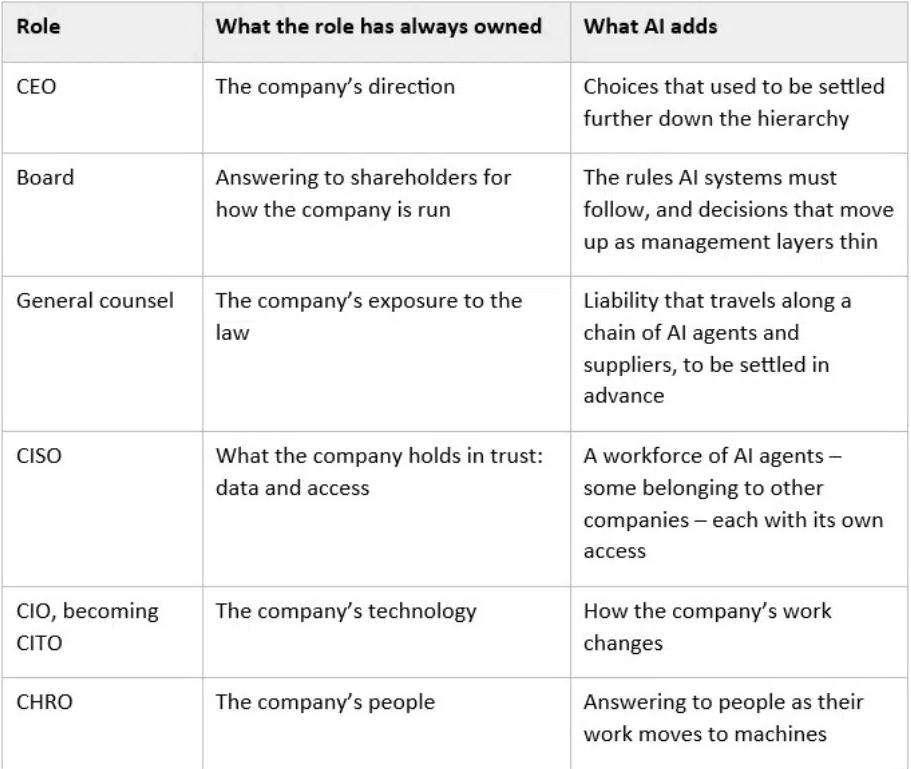
 

These roles will survive. But which roles will not? The most exposed are those built around machine work rather than ownership. A chief strategy officer whose job is to generate and analyze options will find AI doing that work in an afternoon, while the commitment stays with the CEO. The chief AI officer, now common among the organizations IBM surveyed, will last only as long as companies treat AI as a set of tools rather than a change to how they work. While many senior leadership roles will remain, what will disappear almost everywhere is the current version of each role – and often the people in it. The CHRO role will survive. But the current CHRO who administers a human workforce and who cannot imagine leading one in which AI agents do much of the work will not.

Companies will still need leaders who commit them to a purpose and can be held to that commitment.

What the machine leaves

In 1770, Wolfgang von Kempelen unveiled the Mechanical Turk, a chess-playing automaton that was in fact operated by a human master hidden inside its cabinet. The organization scholars Sverre Spoelstra and Nick Butler have recently warned that leadership risks becoming the Turk in reverse: a human face concealing machine intelligence. Much of what executives have always done – gathering information, analyzing it, building options, checking work – was algorithmic all along, work performed by people only because there was no machine to do it yet. Unless we can identify what is irreducibly human in what remains, leaders risk becoming little more than spokespersons for machine intelligence.

One of the things that is, and will remain, irreducibly human is ownership. Companies will still need leaders who commit them to a purpose and can be held to that commitment. They will need people who answer for what the company’s decisions do – to the law, to those they wrong, and to those they affect. That is why the six roles we have described will survive, and why each will become harder rather than easier. The CEO will face more choices that analysis cannot settle. The board will inherit decisions that once sat with layers of management. The general counsel, the CISO, the CIO, and the CHRO will answer, respectively, for exposures, access, change, and human costs that AI multiplies rather than removes. Leaders who decide now which work to hand over and which commitments and consequences they must keep, will be better placed than those who wait for AI to make that division for them.

Original article @ IMD.

Continue Reading

More articles & insights

Dinner Is the New Meditation

Our minds wander nearly half the time, and it makes us unhappy. A three-star chef, a 13th-century Zen monk, and a pot of my mother’s lentils show how dinner can bring us back.

Read article
error: Content is protected !!